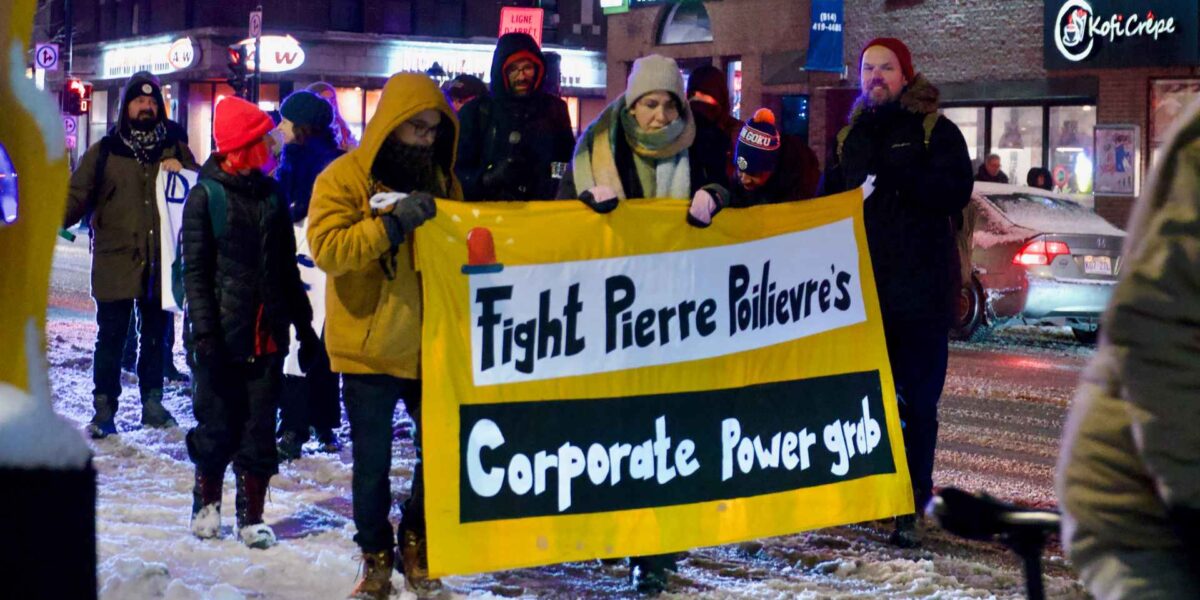
This is a moment when creating pathways to come together on the streets across social movements, across struggles, is critically important. There is a growing tendency in this age of screens to believe that influencers are the answer to the political crisis points that our society is collectively facing, but in real political terms one key factor that can change the political conversation in Canada right now is meaningful street protests.
It is clear that the corporate oriented Conservatives are exploiting the intense housing crisis in Canada with false solutions. Let us spell that out, the Conservatives literally plan to throw billions of dollars at private real estate companies and contracting companies, with few strings attached, a process that is sure to only deepen housing inequalities in this country.
Housing policy in Canada must no longer be shaped by neoliberal ideology and financialization, categorized by investment frameworks, but simply understood as a human right. This point was underlined by housing justice organizers at a recent national convergence in Montréal.
How will this happen? It is really simple, instead of building social housing, real non-market options, like cooperatives, the Conservatives plan to deepen the financialization of housing and literally to allow housing development companies to build-up scams surrounding the crisis, through accessing public funding and then make more for profit housing on the backs of those who are actually facing the housing crisis.
The only response to this cynical manipulation of the housing crisis is to continue to organize at a grassroots level; the 230 Fightback campaign in Toronto, who are organizing a city-wide gathering on April 26, is an inspiring example of this.
It is sickening that the Conservatives are using images of areas like Vancouver’s Downtown Eastside in promotional videos, somehow signaling that they will fix this crisis. It is clear, in between the lines of the nationalist script, that the Conservatives are attacking policies and community projects, like safe injection sites, which are proven to provide a harm reduction framework for people in areas like the Downtown Eastside who are struggling with both addiction but also housing precarity. The Conservative policies deploy fear and criminalization to try to entice people, often living in the suburbs, to vote for them.
On immigration the Conservatives are playing dangerous, violent and racist games.
The Conservative claim that the borders are “out of control,” basically is a dog whistle for racists in Canada. They are saying, often between the lines, that there are too few “old stock” Canadians to use the racist term that former Conservative prime minister Stephen Harper made famous during the last election campaign that Harper ran.
Canadian industries, particularly service industries, along with the health care sector, literally depend on immigrant labour. Without non-status migrants hustling hard to show up in the warehouses, for companies like Amazon, or Dollarama, or to show up on the fields for companies like Savoura in Quebec, things literally wouldn’t happen for those companies. What the Conservatives want to do is to further criminalize migrants, this will result in folks remaining here in even more precarious conditions, so that they can then be even more economically exploited by companies.
The issue with the Liberals is that former Prime Minister (PM) Justin Trudeau talked left and acted right. The Conservatives have benefited from this. Trudeau spoke about welcoming asylum seekers but in the last months in office as PM moved to violently curtail migrant rights. On housing, Trudeau talked about the crisis but offered nothing in regards to the vast non-market solutions needed. Like a massive investment in social and cooperative housing through already existing institutions like the Canada Mortgage and Housing Corporation.
So correctly the Conservatives are calling out the Liberals for the housing crisis, but proposing solutions that in the long term will only deepen the crisis and future see the deepening of financialization of housing which got us into this problem. Trudeau didn’t address this in a meaningful way, and neither does the Liberal Party under Mark Carney, so this is creating room for the Conservatives to play political games, acting as if they are going to actually address the housing crisis, while in policy terms they will absolutely not.
On migration Trudeau talked about international law while sustaining Canada’s deportation machinery and deepening dependency on temporary workers, suppressing wages overall. The Liberals simply didn’t provide the infrastructure to support migrants, creating the context for crisis conditions for so many. This deepening of economic dependency on migrant temporary workers was always going to result in an eventual discourse around mass deportation, while the countless thousands of workers, migrants from the Global South, remain on the farms and warehouses, but in more exploitative conditions.
The issue is that Trudeau and also the NDP have always failed to address the elephant in the room which is the contemporary moral crisis of capitalism, that, as scholar Ruth Wilson Gilmore has outlined, is shaped by colonialist economic systems that are built on human sacrifice. The Conservatives, like Donald Trump in the US, are a direct result of the political crisis of liberal contradictions that are engulfing the entire world right now.
This lack of calls and plans for fundamental change from the political class, which also brings into focus the actual basis of why we are facing a climate emergency, is the exact reason why the Conservatives have any chance at all.
The Conservatives are cynically playing on people’s anger and confusion, they are playing on the fact that the Liberals and the NDP exploited people by speaking left but largely are acting right, addressing none of the key structural issues. They are not fundamentally planning to address the corporate power on Bay St. for example. Why not nationalize some banks? Why not nationalize a number of key industries to boost public revenues and create long standing cooperative models that would be sustainable in the long term?
Social movements and protests are key right now to address this contradiction, to push for real solutions and to create political space to actually talk about the neoliberal colonialist capitalist model which is at the root of our problems.
Support rabble today!
We’re so glad you stopped by! Thanks for consuming rabble content this year.
rabble.ca is 100% reader and donor funded, so as an avid reader of our content, we hope you will consider gifting rabble with a donation during our summer fundraiser today.
Whether it be a one-time donation or a small monthly contribution, your support is critical to keep rabble writers producing the work you’ve come to rely on as a part of a healthy media diet.
Become a rabble rouser — donate to rabble.ca today.
Nick Seebruch, editor