

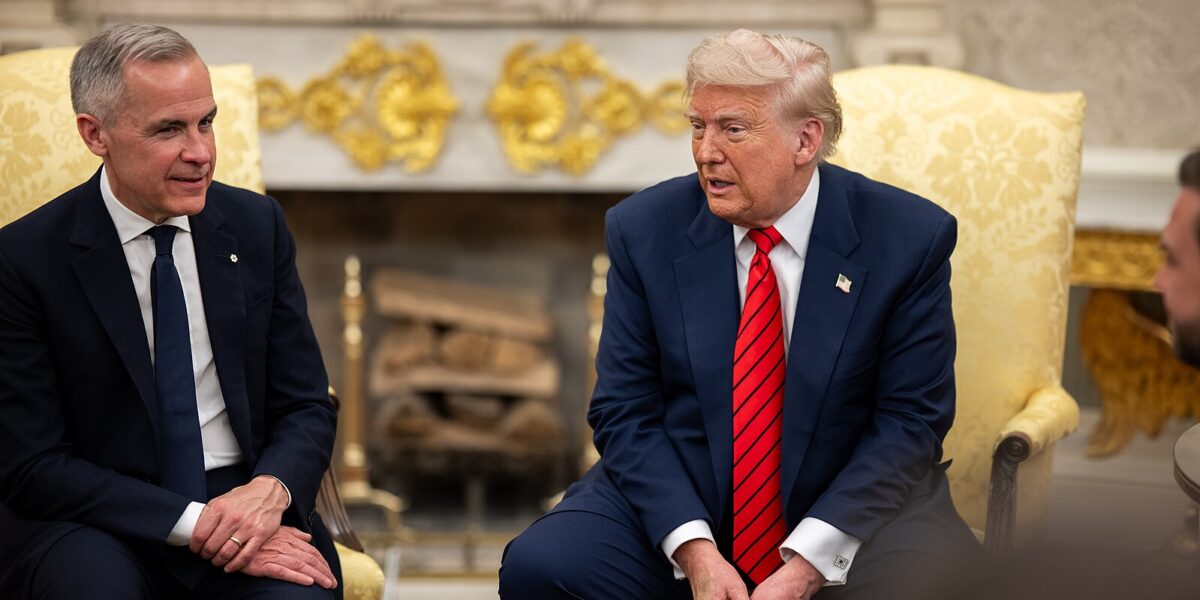
A scant five years ago, Trump praised the Canada-United States-Mexico Agreement (CUSMA), as the “best and most important trade deal ever made by the USA.” Now Trump thinks he was screwed. He blows up every trade deal he touches because there is always more to grab. He trashed the World Trade Organizations’s Appellate Body, the Transpacific Partnership, North America Free Trade Agreement, and now, at least in practice if not in law, the CUSMA.
Trump doesn’t want trade deals, he wants shakedowns. According to the Financial Times, hastily agreed-upon deals with the UK and Japan don’t even have a legal text. Furthermore, the deal struck with the EU this past weekend levies 15 per cent tariffs on most goods, including autos. It was reported to have been struck in an hour at Trump’s golf course in Scotland.
As trade policy experts who have written a book on global populism, we believe it’s highly doubtful any of these so-called deals will ever become anything more than a set of general terms that are open to revision at all times. But at this point, that’s not exactly news to anyone who has been paying attention.
Trump’s Liberation Day tariffs blew a massive hole in the global trading system. And the promised “90 deals in 90 days” never happened. So now countries the world over are expecting their exports to face beggar-thy-neighbour restrictions approaching the heights of the infamous Tariff Act of 1930. For example, Canada’s trade letter announced a baseline tariff of 35 per cent, with 10 per cent for oil and gas, and 50 per cent for steel, aluminum, and copper.
Eating bitterness
The Chinese call living through hardship, “eating bitterness” (吃苦, chī kǔ). That term surely describes the feelings among Canadians, now that the shock of the first six months of the Trump Administration have worn off.
The new American model for trade relations is one of dysfunction and co-dependence, a term used by psychologists to describe the pathological dynamics of an abusive relationship. But countries aren’t people, and Canada can’t walk out the door.
Trump will try to crack our nut, with or without a new trade deal. It is now clear that an American empire, unconstrained by law or reason, is willing to inflict substantial pain on weaker partners.
We have little experience with resisting this systematic humiliation. As junior partners of first Britain and then the United States, Canadians grew comfortable with a century of mostly benign indifference. Now that we are in the cross-hairs, we have few natural defenses against the animal aggression of the Trump Administration.
So far, Canadians have rallied around the flag, partly out of fear and partly out of wounded pride. But as voters and consumers, they are still unprepared for the kinds of sacrifices it will take to pull back from the American market. We will need to reorient our economy to compete in new markets in everything from entertainment and cloud computing, to lumber, minerals, and oil.
A third of Canadians have already given up American holidays. But fewer have cancelled Netflix, and hardly anyone is dumping their iPhone. Canadians are frozen between hope that Trump will be gone by January 2029, and fear that getting from here to there will require a tolerance for pain that has been so far untested.
Carney’s challenge
Prime Minister Mark Carney excels as a high-level technocratic fixer, and his backroom abilities are impressive. By contrast, Trump is a master performer and a bully par excellence. He is callous, vindictive, and his belief that might makes right is bone deep. He also knows that the Canadian government, like Europe and the UK, will retreat in the face of his wrath.
The Liberal government wants to increase interprovincial trade and participate in the new EU system for military procurement. That’s a start. But it’s not enough. Our position is more precarious than most Canadians realize. If we are stripped of our CUSMA protections, Canada will face tariffs far higher than Europe’s. Our economy would implode, giving Trump the opening he needs to offer his only solution, annexation.
Two choices
As a former banker, Carney is used to thinking long-term and that makes him something of an anomaly among modern politicians. He understands that there are only two paths forward: a slow slide into the swamp of American authoritarianism, or a determined pivot towards greater autonomy, painful as that may be. Both are hazardous; we are balancing on a perilous ledge.
In the first instance, Canada will reluctantly conclude some sort of handshake trade deal on the premise that the tariff on offer is lower than the exorbitant rate threatened on July 10, and put into place July 31. It won’t come with any of the security and stability that we’ve come to expect from North American trade arrangements. Trump will continue his assault on the rule of law, becoming more powerful and more capricious.
The only dubious upside is that the rest of the world is in the same boat. Americans are paying tariffs on goods from everywhere. Nobody has any clarity on when they rise and fall.
Even so, the great danger of treating this lawless administration like a rational actor, is that we will be pulled deeper into competitive authoritarianism. We will be expected to march in lockstep with the Dear Leader and react with speed and alacrity to his moods and fancies. We don’t have an ocean’s distance and the market heft that Europe has.
The more on-side we remain, the faster he will dismantle our industries and send them south.
In the second instance, negotiations will drag on as Trump continues to kick the can down the road. He recently announced another extension for Mexico. The Carney government will continue to work towards diversified trade, strengthening the east-west ties inside the country and strategically using public debt to finance the next clean energy industrial revolution.
None of this will come close to replacing lost American clients. Nor will it stabilize whatever is left of the postwar North American partnership. But something must be done and it’s a reasonable place to start. Even so, every path out from under the American elephant is narrowed by entrenched provincial interests, Alberta separatism, and the complications of negotiating with many future partners in Europe, Asia, and Latin America. It’s a tall order; not impossible, but not for the fainthearted.
Of course, any rejection of America’s authoritarian brand of pseudo-liberalism will be complicated by Trump himself. He is unlikely to allow Canada and Mexico to continue with the status quo of sheltering under the CUSMA indefinitely now that Europe has caved to his tariff demands. The CUSMA is hanging by a thread. Future trade conflict with the Trump regime is inevitable, and an acquiescent Congress may roll over and cancel it outright. Trump promised economic coercion, and this is the only point on which he can be trusted to keep his word.
Support rabble today!
We’re so glad you stopped by! Thanks for consuming rabble content this year.
rabble.ca is 100% reader and donor funded, so as an avid reader of our content, we hope you will consider gifting rabble with a donation during our summer fundraiser today.
Whether it be a one-time donation or a small monthly contribution, your support is critical to keep rabble writers producing the work you’ve come to rely on as a part of a healthy media diet.
Become a rabble rouser — donate to rabble.ca today.
Nick Seebruch, editor