

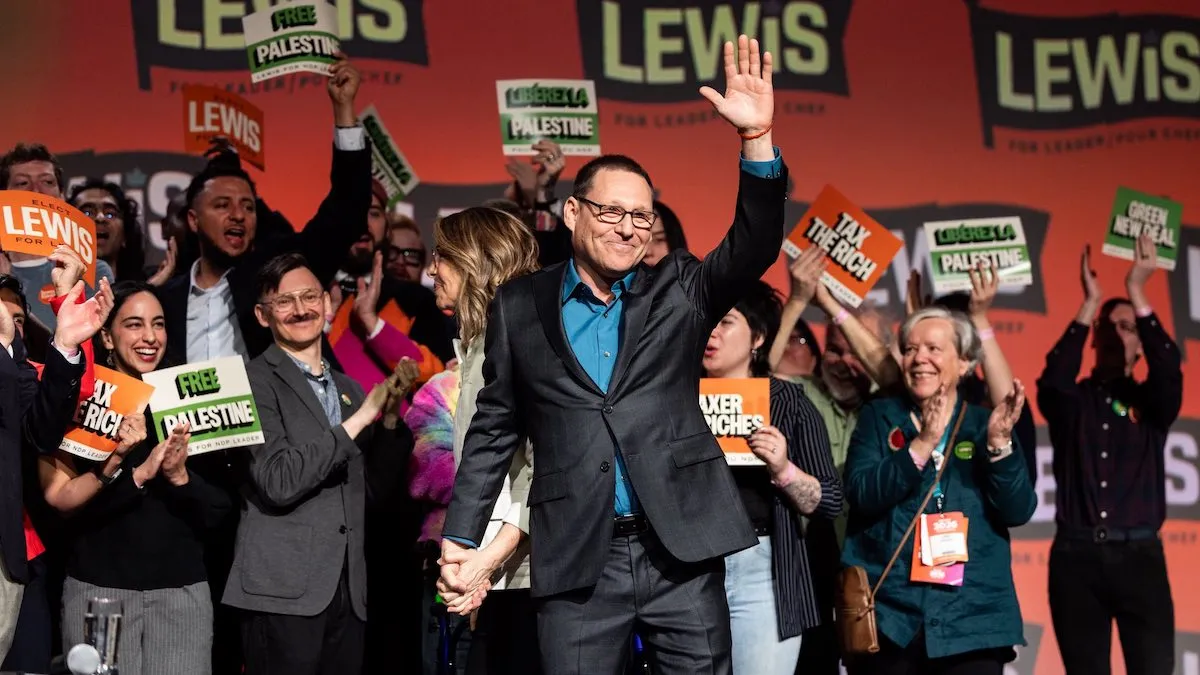
Avi Lewis’ quest to rebuild the NDP will be a journey of a thousand miles.
He inherits the New Democrats in disarray one year after their worst election result in history, once again losing their official party status in federal parliament. The only other time this happened was in 1993.
And with Nunavut MP Lori Idlout abandoning the NDP for the Liberals last month, along with the defiance of Alberta’s and Saskatchewan’s NDP leaders, perhaps all the embattled party has going for it right now is a mere six seats in the House, the right to remain silent during Question Period, and millions of dollars in debt.
But who doesn’t love a good comeback story?
For his part, since winning the NDP’s leadership race, Lewis has spent his first two weeks driving the case for the rebound. The party will soon regain almost $670,000 in parliamentary financing for its research office and salaries, and Lewis has discovered that it’s easy to make headlines, whether by reminiscing about his late father and his family lineage of NDP leadership, or by scolding the government for not protecting Canadian consumers enough by banning algorithmic grocery-store pricing.
In a world where TikTok and Instagram provide a vastly wider reach than the visitor galleries of parliament, it might not be a bad thing for Lewis to take his filmmaking and advocacy skills on a roadtrip.
At least for now.
When asked about this strategy, Lewis wrote to rabble.ca: “I’ve consulted with my caucus and they have spoken with one voice: it’s important for me to stay out on the road, traveling the country and engaging the struggles of Canadians in this historic cost of living emergency. We have lots of energy and excitement at our base, and I plan to continue the work of building there too – raising money, identifying candidates and key organizers, and getting our ground game ready for the next election, whenever it comes.”
But given that last month’s five floor crossings along with this past Monday’s by-election results have handed the Liberals a firm majority government, Prime Minister Carney is unlikely to call the next general election until three and a half years from now, at the end of 2029.
So, how long can Avi Lewis lead the NDP before seeking a seat in the House of Commons?
According to pollsters, this really is a question of opportunity.
The firm Mainstreet Research published results of a survey last month in the Toronto’s Beaches – East York riding, which showed that Avi Lewis could potentially win a 42.6 per cent plurality of votes should a federal by-election take place there in the next six months, as expected.
A federal seat in the Beaches is likely to become vacant as Liberal MP Nathaniel Erskine Smith has said he will relinquish his position to run for a provincial seat in Scarborough Southwest.
Interestingly, the provincial seat Erskine Smith hopes to win becomes vacant as a result of Monday’s by-election outcome, in which Doly Begum changed her party affiliation from the Ontario NDP to the federal Liberals.
“With the by-election sweep in the rear view mirror and a [Liberal] majority secured, the impact of this by-election is now less dramatic. However, the irony remains that an NDP MPP resignation could trigger a federal by-election that the NDP could secure under the right conditions,” said Quito Maggi, CEO of Mainstreet Research.
This shuffle of seats the way Maggi speculates would certainly be a nice redemption narrative for the NDP should Lewis choose to run in Beaches – East York. Rather than simply losing Doly Begum as provincial minister in the short term, yet another blow to the New Democrats, the shakeup in these two Toronto ridings could allow Avi Lewis to gain a solid federal NDP seat in the long term.
“Two of three ‘what ifs’ have occurred since this poll was taken,” said Maggi of his March 2026 survey. “Avi Lewis won the leadership of the NDP, and the Ontario Liberal nomination contest is scheduled for May 9th. This could trigger a by-election in Beaches – East York before the end of 2026. Although it’s unclear whether Avi Lewis might run there, it’s an interesting possibility.”
Lewis does have a legitimate claim to run in Toronto, having been raised there, and seeing that his grandfather and father both represented Toronto ridings. But the new NDP leader currently lives in the Vancouver area and has twice run there since 2021, though unsuccessfully.
And since rumors that North Vancouver-Capilano MP Jonathan Wilkinson might be taking up a diplomatic post, thereby resigning his seat, have so far not materialized, there’s no true horizon for a Vancouver-area by-election where Lewis could theoretically make another bid for a seat in the House of Commons.
While an NDP source close to Lewis suggested that it’s too early to predict where he might seek election, another pollster, David Valentin, a principal at Liaison Strategies, said that, “Luck has to provide guidance.”
“I think it’s an interesting question as to where Avi Lewis is going to run. If the aim is to grow seats, you’ve got to run the leader someplace that’s not already held,” said Valentin. “If the aim is to get the leader into Parliament and consolidate, then maybe he would run in Vancouver Kingsway, but I think from his perspective he has to figure out, okay, there might be a by-election in the Beaches if it’s not going to be me. Who is it going to be?”
When discussing the roadmap of a comeback, Lewis refers to Jack Layton, and indeed the NDP is no stranger to a full resuscitation from a near-death experience.
The NDP’s bleakest years before the present came under Audrey McLaughlin’s leadership, when in the 1993 federal election the NDP received only six per cent of the vote along with nine seats, three short of the requirement for official party status.
Alexa McDonough managed to rebuild the caucus somewhat by 2002, when Jack Layton took over the party’s leadership.
It then took Layton eight years to bring the NDP from 13 seats in 2003 to the historic surge in NDP popularity by the election of 2011, when the party won 103 seats in parliament – and effectively supplanted the Bloc Quebecois in Quebec – the legendary “Orange Crush.”
Layton’s strategy to get there was methodical and painstaking, and did involve a lot of time criss-crossing the country and building up grassroots support. The NDP’s ground game in Quebec was so strong that in the 2011 election one MP even managed to win her seat despite barely speaking French at the time, and spending most of her campaign on vacation in Las Vegas.
Avi Lewis’ New Democrats are working with considerably less, and have more ground to cover, but there’s no clear timeframe on how long a comeback should take.
Can he pull it off?
While he figures that out, he might give some thought to Beaches – East York.
Support rabble today!
We’re so glad you stopped by! Thanks for consuming rabble content this year.
rabble.ca is 100% reader and donor funded, so as an avid reader of our content, we hope you will consider gifting rabble with a donation during our summer fundraiser today.
Whether it be a one-time donation or a small monthly contribution, your support is critical to keep rabble writers producing the work you’ve come to rely on as a part of a healthy media diet.
Become a rabble rouser — donate to rabble.ca today.
Nick Seebruch, editor