

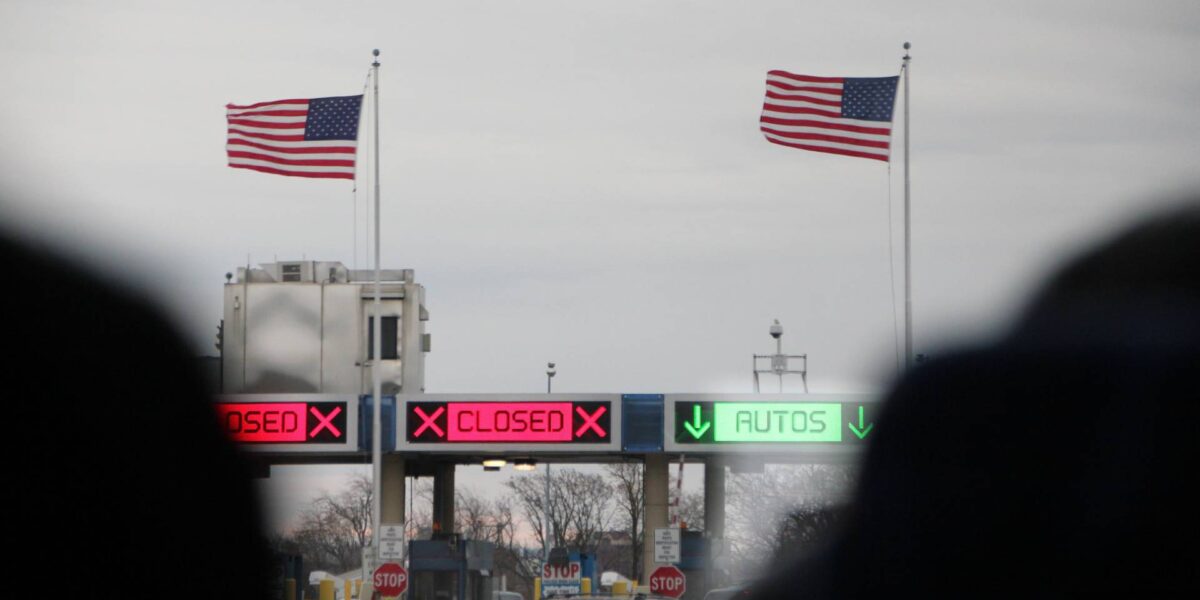
A lot of Canadians are boycotting travel to the U.S. these days.
For most, those boycotts make a political statement.
Canadian boycotters do not want to, in any way, support a country ruled by a toxic would-be dictator.
They want nothing to do with an out-of-control President, who calls whole races of people garbage (in a manner that does not echo or rhyme with Nazi hate propaganda, but quite faithfully reproduces it), and who sits up at night spewing malevolent lies about Canada.
Those are pretty legitimate political reasons to shun any country – as a gesture of protest and resistance.
But this writer has another motive for not traveling to the U.S.– a motive beyond making a political statement.
That motive is fear.
Until not too long ago, I had been contemplating a trip across the border to visit some close relatives – or more accurately relatives of my U.S.-born wife.
Some of those folks have health problems, and others are not so mobile, for a number of good reasons. In normal times, it would be easy for us to get in our car and drive four or five hours south.
The roads are good, and we’ve done those trips many times, with no untoward incidents at the border.
Indeed, in the past, U.S. border guards were friendly and deferential. Mostly they paid us little heed and, after a perfunctory glance at our ID, waived us on.
There was one time many years ago, in the immediate post 9-11 period, when one border guard was a bit skittish.
After examining my passport, he inquired, with a touch of suspicion, about the stamps he saw from a number of different countries, including Poland. I allayed his concerns by explaining that my work required a certain amount of international travel.
The border guard did not pursue the issue, and that minor delay did not even last five minutes.
We’re in a rougher and more dangerous time
It is, of course, possible that we would get the same indifferent-to-welcoming treatment as we have in the past at the U.S. border today. Maybe it’s even likely.
But if a border guard were to demand my phone or, even worse, enter my name into a search engine on his computer, the whole experience could go south in a big hurry.
The following is the warning about crossing the border to the U.S. the Canadian ministry of Global Affairs has put on their web site:
Every country or territory decides who can enter or exit through its borders and the Government of Canada cannot intervene on your behalf if you do not meet entry or exit requirements for the United States.
Individual border agents often have significant discretion in making those determinations. U.S. authorities strictly enforce entry requirements.
Expect scrutiny at ports of entry, including of electronic devices. Comply and be forthcoming in all interactions with border authorities. If you are denied entry, you could be detained while awaiting deportation. (Emphasis added)
The government of Canada has buried the lede when it comes to this warning. You will find it near the very bottom of a long series of items related to travel to the U.S.
At the outset, the Global Affairs Canada (GAC) website is, indeed, quite reassuring. It says Canadians only need to take “normal security precautions” when travelling to the U.S.
GAC then lists a long series of such precautions, all of which would exist even in normal times.
They list such matters as petty and violent crime, gun violence, home break-ins, fraud, and even the hazards of mountaineering.
Only after they get through all that other stuff does GAC’s website arrive at what it calls: “Entry and exit requirements”.
That’s where we learn about the danger to Canadians not of non-state actors, such as criminals or steep mountains, but of the U.S. government itself.
Reports from Canadians I know who have crossed the border over the past few months have been mixed.
Some breezed through without incident. Others faced intrusive questions and aggressive treatment.
In a few cases, the lengthy interrogations caused them to miss their scheduled flights, forcing them to take later ones.
Once you’re blacklisted it is hard to get de-listed
Now, I might be tempted to attempt a family visit to the U.S. and if harassed at the border, or refused entry, simply turn around and go home.
I could then decide to wait for sanity to return to the U.S. before trying another trip.
There are a couple of problems with that plan.
In the first instance, once you arrive at a land border with the U.S. you are on their territory. You cannot simply decide to turn around and go back to Canada. That decision is up to U.S. border officials.
And once you’re in their country those officials can detain you, for quite a while, it seems, with no due process. That experience is not a prospect anyone should dismiss lightly these days.
And even if the border guards were simply to refuse a person like me entry, and invite me to go back to Canada, making a future trip to the U.S., if and when sanity reasserts itself there, would not necessarily be so easy.
After being officially refused entry once, my name would almost certainly find itself onto some sort of blacklist, maybe more than one. Bureaucracies being what they are, I could still be barred entry even once there was a more benign administration in charge in Washington.
Once your name gets on a U.S. government banned list it is devilishly difficult to get it off.
I know this from experience.
In 1950, near the beginning of the Cold War and during the burgeoning Red Scare, the U.S. Congress passed an Internal Security Act, the McCarran Act, named after Nevada Democratic Senator Pat McCarran, its principal sponsor.
Then-President Harry Truman vetoed what he considered to be dangerous and excessive measures, but both Houses of Congress had the necessary two-thirds of the votes to overturn his veto.
The McCarran Act included many Draconian provisions, some of which will sound eerily familiar today.
Among those were: requiring so-called Communists to register with the U.S. Attorney General, the power to revoke the citizenship of naturalized citizens deemed to be subversives, and the authority to detain people without trial on the grounds they might engage in espionage or sabotage.
That last provision gave the Act another of its names: the Concentration Camp Act.
The legislation also barred non-Americans considered to be subversives from entering the U.S.
To enforce the banning of foreign nationals, U.S. officials compiled a long list of unwanted non-Americans (including thousands of Canadians). Many of those had been associated with a large variety of political and civil society organizations the American government considered to be inimical to its interests.
I knew Canadians whose names found their way onto that list. Because U.S. border guards’ application of the law was inconsistent, some managed to travel to the U.S. nonetheless, while others were not so lucky.
A number of black-listed Canadians discovered that while U.S. border guards stationed at Canadian airports were punctilious about checking the list, their colleagues at land borders were likely to take a more lackadaisical approach.
And so, they avoided airports and crossed the border by car. Sometimes they would then catch a plane from a U.S. airport near the border to a more distant location.
Even after the U.S. Congress repealed most provisions of the McCarran in the 1970s, border guards continued to check the blacklist. For many years, well into the 1980s, they continued to refuse entry to some Canadian travellers.
With time, the entire exercise took on comic opera quality.
In most cases, the banned people were well on in years, and the political organizations with which they had been associated were often defunct. Many of those organizations went back many decades, in some cases to the Spanish Civil War era of the 1930s.
In those less confrontational times, the process of denying a person entry to the U.S. was, for the most part, polite and genteel.
There was no question, during that era, of U.S. border guards submitting would-be Canadian visitors to any form of interrogation, let alone detaining them.
It is not so friendly now, in 2026.
Caution is the watchword
The somewhat paranoid, but relatively subdued, anti-Communism of the Cold War era has given way to an aggressive and hostile form of proto-Fascism.
Politesse and gentility are not in the current playbook of ICE or any other U.S. Homeland Security agency. They are certainly not part of the current U.S. administration’s rhetorical arsenal.
These days, in the time of Trump, when Canadians arrive at the U.S. border, there’s always a chance U.S. officials will greet them with intrusive inquiries and humiliating verbal assaults.
The chances those same officials might resort to more than words, to physical tactics such as detention, might not be as great, but they are nonetheless real.
And folks such as me, who hope there will be a time when they will feel more comfortable travelling to the U.S. – home to much that is truly great, such as jazz, theatre, and the Adirondack mountains – won’t want to get themselves onto any sort of blacklist.
That’s a list from which it could be difficult, if not impossible, to extract oneself.
Being on such a list might make it extremely difficult to ever visit the U.S, again. That is not a prospect this writer relishes.
The conclusion?
When it comes to travel to the U.S., for many Canadians, including this one, caution is the better part of valour.
Support rabble today!
We’re so glad you stopped by! Thanks for consuming rabble content this year.
rabble.ca is 100% reader and donor funded, so as an avid reader of our content, we hope you will consider gifting rabble with a donation during our summer fundraiser today.
Whether it be a one-time donation or a small monthly contribution, your support is critical to keep rabble writers producing the work you’ve come to rely on as a part of a healthy media diet.
Become a rabble rouser — donate to rabble.ca today.
Nick Seebruch, editor

