Between January 8 and 11, 2026, Syrian government forces and Turkish‑backed militias assaulted and besieged Kurdish neighbourhoods in Aleppo, Syria, killing civilians and forcing mass displacement.
The attacks sparked protests among Kurds worldwide, including large demonstrations across Canada, where the diaspora urged the federal government to pressure Damascus to halt the violence against Kurdish communities.
Ahmed al-Sharaa, a former Islamist commander linked to al-Qaeda-affiliated groups, overthrew Bashar al-Assad on December 8, 2024, and was subsequently welcomed by the United States and Turkey through diplomatic engagement.
Since al-Sharaa assumed power, Syria’s religious and ethnic minorities: Druze, Christians, Alawites, and now Kurds, have faced growing exclusion, insecurity, and targeted violence. Despite official claims of protecting minority rights, al-Sharaa’s rule has deepened sectarian divisions and pushed Syria closer to renewed fragmentation, with the recent attacks on Kurdish communities marking the latest link in this chain of assaults.
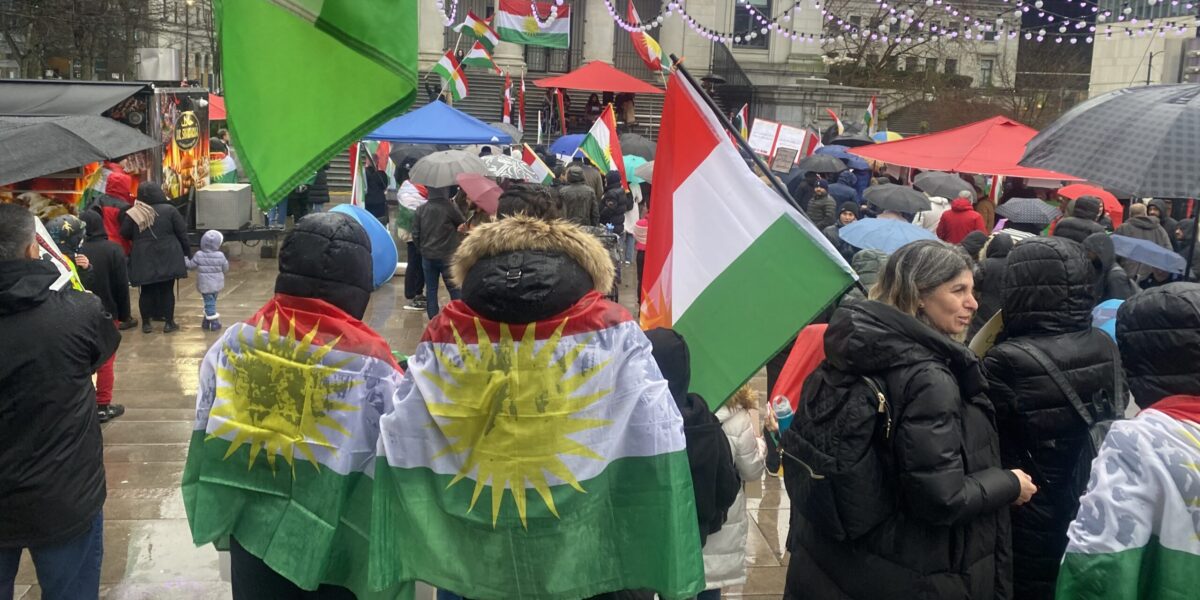
Agid Omar, a Canadian Kurd, joined a rally at the Art Gallery in downtown Vancouver on Saturday, January 11, to support his people in Syria. He spoke with deep concern about the attacks.
“I have three children,” Omar said. “When I see Kurdish children suffering under Syrian government forces, I feel like I am walking in their fathers’ shoes. It breaks me.”
Throughout the Vancouver protests, Omar stood in the heavy rain, flying the Kurdish flag and chanting slogans. He described the actions of the Syrian and Turkish militias as violent and cruel.
“Many of the civilians targeted weren’t armed fighters; they were unarmed, including children. I saw children asking the militias for water, and they responded with guns and intimidation,” he said.
Omar also spoke about the personal toll the events had taken on him.
“I have nightmares about what I saw. I cannot get the images out of my mind. My psychological state has suffered greatly,” he said.
He warned that the threat is not limited to Syria.
“The Syrian and Turkish militias are not only threatening Kurds in Syria, but also here in Canada. I was personally threatened after the protest. This is a terrorist threat for everyone,” Omar said.
An account of the recent attacks on Kurdish neighbourhoods
On March 10, 2025, Syria’s government and the Syrian Democratic Forces (SDF) reached an agreement to integrate the Kurdish-led forces into the national army and expand government control over northeast Syria. The deal included a nationwide ceasefire, recognition of Kurdish rights, and the transfer of public institutions, such as borders and oilfields, under central government authority.
Following the agreement, SDF forces withdrew from the Kurdish neighbourhoods in Aleppo, and local security forces, the Asayish, took over control. First, the withdrawal was completed peacefully, and residents initially felt some relief.
Then, on January 6, 2026, under U.S. supervision, Israel and Syria reached an agreement in Paris. However, tensions quickly escalated. The Syrian army cut off electricity, water, and food supplies to the areas involved and declared them a “closed military zone,” warning that anything inside could be targeted.
Finally, from January 8 to 11, Syrian forces carried out an assault to defeat the Asayish in the Kurdish neighbourhoods of Sheikh Maqsoud and Ashrafieh. The attacks forced over 100,000 residents to flee, and at least 23 civilians were killed. According to Kurdish observers, the Syrian forces broke the earlier agreement, exploiting the changing regional dynamics following U.S. support for Ahmed al-Sharaa.
Voices from the Kurdish diaspora
Khidir Sheikh Ahmed, a Syrian Canadian Kurd living in Saskatchewan, is a social media influencer who has closely followed developments in Syria. He expressed deep concern for his family and relatives in Rojava, describing the recent attacks on Kurdish communities as an attempt at demographic change.
“The terrorists, with the support of Turkey, are displacing Kurdish children, women, and the elderly to alter the demography of Kurdish areas,” he said.
Sheikh Ahmed also believes that the United States supports Syria’s new regime to protect its interests and limit Iran’s influence in the region.
Ahmed Binavi, a Calgary-based political analyst, organizes protests and demonstrations in support of Kurdish communities. He highlighted the personal toll the conflict has on Kurdish Canadians: “Many have parents, siblings, and relatives living near conflict zones with limited access to safety, medical care, or communication. For our community, this is not distant news; it is personal, immediate, and ongoing trauma.”
Binavi has also taken formal action, sending letters to the Parliament of Canada and Prime Minister Mark Carney detailing civilian harm, displacement, and legal concerns.
“We continue to update elected officials with information from the ground,” he said, emphasizing the need for international attention and support.
Binavi emphasized the diaspora’s ongoing advocacy efforts.
“We provided written documentation detailing civilian harm, displacement, and legal concerns, and we continue to update elected officials with information from the ground,” he said.
Sheikh Ahmed expressed deep concern for his family and relatives in Rojava.
“Sheikh Ahmed described the attackers as ‘terrorists,’ with the support of Turkey, who are displacing Kurdish children, women, and the elderly to change the demography of Kurdish areas,” he said.
During the protests, the Kurdish diaspora called on Canadians for support. Omar spoke directly to both the public and the federal government, urging them to remember the Kurds’ successes in defeating ISIS and other extremist groups.
“The Kurds now need support to protect themselves,” he said.
Diaspora appeals to Canada
The protests by the Kurdish diaspora in Canada highlight the urgent need for global attention, and cannot remain silent in the face of such violence.
The protests by the Kurdish diaspora in Canada highlight the urgent need for global attention to the attacks on Kurdish communities. As Omar and Binavi emphasized, protecting civilians and defending human rights is not only a matter of local concern, it is a global responsibility. Canadians, and the international community, cannot remain silent in the face of such violence.
Support rabble today!
We’re so glad you stopped by! Thanks for consuming rabble content this year.
rabble.ca is 100% reader and donor funded, so as an avid reader of our content, we hope you will consider gifting rabble with a donation during our summer fundraiser today.
Whether it be a one-time donation or a small monthly contribution, your support is critical to keep rabble writers producing the work you’ve come to rely on as a part of a healthy media diet.
Become a rabble rouser — donate to rabble.ca today.
Nick Seebruch, editor