
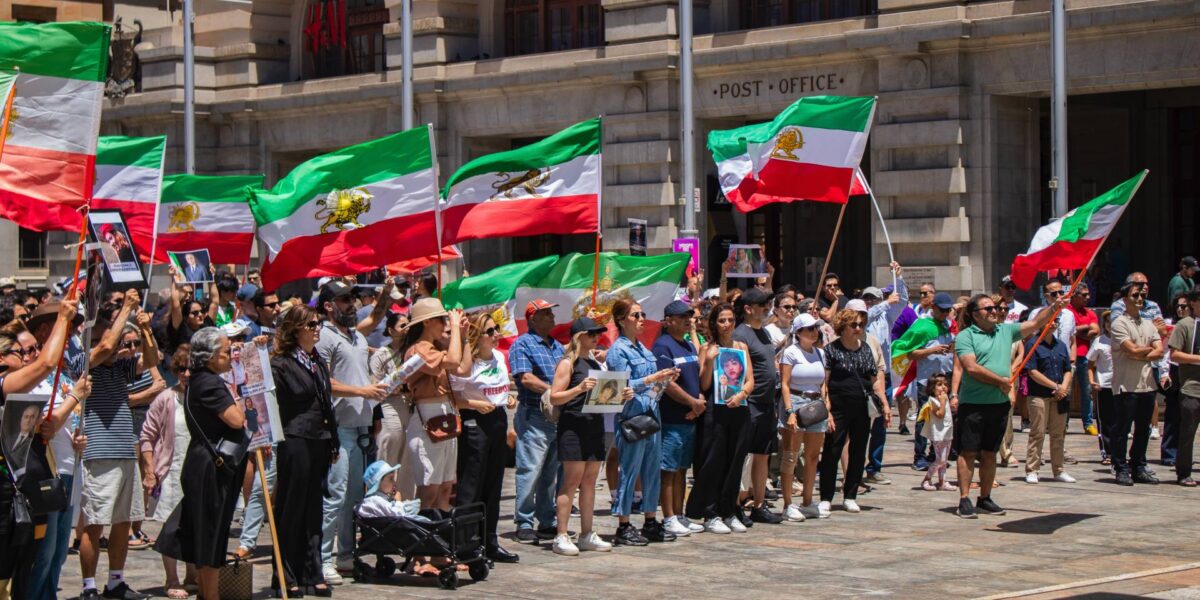
Anti-regime protests have broken out across all 31 of Iran’s provinces. In response, authorities have launched a sweeping crackdown marked by the killing of protesters, mass arrests, and widespread internet shutdowns, further isolating Iranians from the outside world and making it increasingly difficult to report events on the ground.
The American based Human Rights Activists News Agency states that over 2,000 people have been killed and over 16,700 people have been detained. There are fears that the death toll is higher than what is currently being reported and will only continue to grow in the coming days.
“We are at a pivotal moment in our history… Nothing like this has happened in my lifetime,” said Arash Azizi, an Iranian author, historian, and research associate and lecturer at Yale University.
Long-simmering discontent with the Iranian government was pushed to a breaking point by soaring inflation. Bazaaris, an influential class of merchants who have often aligned with the regime through their ties to Iran’s Shiite clergy, closed their shops in protest, out of their deep frustration with the country’s worsening economic conditions. This quickly escalated into a nationwide movement where Iranians have been airing a broad range of their grievances with the Islamic Republic.
Iran’s international standing
The last time Iran experienced protests on a comparable scale was in the aftermath of Mahsa Amini’s murder in 2022. However, the protests in 2026 have spread more rapidly, grown more broadly nationally, and have in turn elicited a more brutal and swift response by the Iranian regime.
Azizi notes that the regime is in a significantly weaker position than it was in 2022 despite enacting a more intense crackdown.
“That regime had some confidence … it not only survived a revolution, but it also actually improved its regional position. In the midst of that movement, it re-established diplomatic ties with Saudi Arabia; it joined the Shanghai Cooperation Organization. Now the situation is totally different in Iran. It has lost all of its regional militias; it lost its allies in Damascus and Caracas; it finds itself very much isolated, and it finds its domestic position much more untenable,” said Azizi.
Since 2022, the capacity of Iran’s proxy militias across the Middle East have been significantly weakened, the Assad government in Syria has been overthrown by opposition forces, and in early 2026, Nicolás Maduro, an ally long tied to Tehran, was removed by the US. This has all led to the Iranian regime being in a considerably weaker position abroad.
Some analysts argue that this erosion of international influence has also weakened the government’s domestic position, undermining the regime’s narrative of strength and resistance and contributing to its sense of political vulnerability.
“The regime has lost its narrative of what it was doing… When we talk about the Islamic Republic we are talking about an ideology … it’s anti‑Western in the sense that it is punching the United States and wants to destroy Israel but when it’s not able to do that it loses a fundamental leg of its ideology … it feels more under siege and… has to give up one of its fundamental building blocks,” said Azizi.
“The Iranian regime now has to confront not just popular anger, but also foreign pressure and a lot of intra-regime machinations,” with some ruling elites beginning to reassess their loyalty to the Ayatollah, said Azizi.
Foreign intervention
Though President Trump claims he’d “been informed by very important sources on the other side” that executions of detained protesters would cease, the administration is still weighing whether to proceed with military action.
The threat of military intervention has prompted mixed responses.
“I am sure Iranians will cheer if Trump hits an IRGC (Islamic Revolutionary Guard Corps), base or two so long as civilians are not hurt, ” said Azizi.
On the other hand, Senator Bernie Sanders released a statement saying: “Let us not forget that the current, abhorrent regime in Iran is itself the product of a Western-backed intervention… In 1953, a British and American-orchestrated coup overthrew the democratically elected government of Mohammad Mosaddegh in Iran. This was done primarily to protect Western oil interests… U.S. military intervention is not the answer. It failed in the past and will fail again. The United States must stand with the Iranian people, not over them”.
In response to some who have expressed skepticism about the protests, fearing they could be instrumentalized to serve Western interests, Iranian activists have pushed back against that framing.
“Frankly, I am a little tired of wanting to justify the struggles of my people to outsiders, even if I sometimes understand the political necessity of this. Iranians live under a brutal capitalist dictatorship which denies them all freedoms and kills them when they protest. Anybody with a minimum of decent politics should have no problem opposing this,” Azizi said.
“I don’t think Western intervention is useful in Iran today. I am not sure how it will be a strategic help to the opposition movement. Iranians are faced with a terribly murderous regime and they can use any help they can get. But I don’t see how they’ll benefit much from foreign attacks. The job of overthrowing the regime is up to Iranians themselves,” Azizi added.
Iran’s future
While there is no clear path yet to democratize Iran post the Islamic Republic that should not be confused with disagreement over a broad set of aspirations among the Iranian people.
“There are basic things that the vast majority of Iranians have in common. They want the territorial integrity of Iran to be preserved, they want democracy…. they want women’s equality, unlike what we have under the regime, they want a prioritizing of their own economic development. We want a normal life,” said Azizi.
Watching these protests Iranians feel a mix of optimism and fear.
“To quote Antonio Gramsci, I combine optimism of the will with pessimism of the intellect. In other words, I want to be positive as we fight for a different Iran. But there are many concerns and many dangers ahead. The worst case scenario is Iran’s disintegration and a prolonged civil war. The best case scenario is a democratic transition but it will be tough and it’s hard to see it as a likely outcome at the moment,”, said Azizi.
“But we will never cease fighting for democracy and social justice,” he adds.
Support rabble today!
We’re so glad you stopped by! Thanks for consuming rabble content this year.
rabble.ca is 100% reader and donor funded, so as an avid reader of our content, we hope you will consider gifting rabble with a donation during our summer fundraiser today.
Whether it be a one-time donation or a small monthly contribution, your support is critical to keep rabble writers producing the work you’ve come to rely on as a part of a healthy media diet.
Become a rabble rouser — donate to rabble.ca today.
Nick Seebruch, editor