

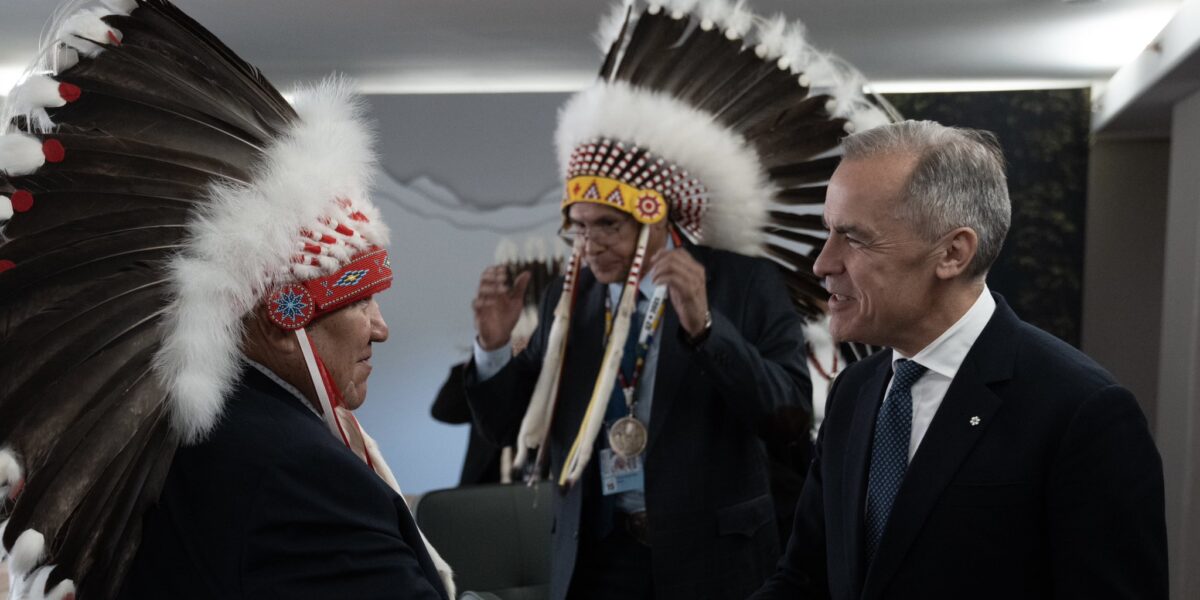
Indigenous groups and advocates for the environment are lining up to oppose Prime Minister Mark Carney’s signature Build Canada Bill, C-5.
Like the Ontario Doug Ford government’s Bill 5, Carney’s bill seeks to speed up the approval time for massive, “nation-building” projects.
Ford’s bill creates special economic zones on Crown land, where federal and provincial rules can be suspended to allow resource extraction projects (including mining for critical minerals) to go ahead at great speed.
Much of that Crown land is Indigenous territory, largely in northern Ontario, and Indigenous communities in Ontario objected vigorously to the legislation. Ford pushed it through nonetheless.
Indigenous groups, notably those in Ontario, have also expressed opposition to the federal bill, C-5.
And a number of environmentalists have put forward thorough, fact-based objections to the C-5.
Ecojustice, for instance, has provided a cogent and detailed legal analysis.
The federal NDP, despite its tiny parliamentary contingent and meagre financial resources, has issued a lengthy fact sheet on the flaws of C-5.
Among the many drawbacks and dangers New Democrats identify are: allowing cabinet to subjectively define what constitutes a project of national interest; giving private corporations equal status to Indigenous peoples as stakeholders in nation-building projects; and bypassing about half a dozen key pieces of federal environmental legislation.
The Conservatives generally support C-5. Their only objection is that it does not go far enough.
But both the Bloc Québécois’ MPs and the sole Green MP in the House also oppose Carney’s bill.
Even some mainstream media commentators have come out against C-5.
Notably, the Toronto Star’s Althia Raj wrote: “There is no mechanism through which public consultations can result in a project’s green light turning into a red light … The entire review is focused on how to get a project built, not whether it is a good idea.”
The time is running out for the Liberals to correct their course on C-5
Unfortunately, other more dramatic events – the G-7 and the Iran-Israel war not the least of them – are distracting Canadians’ attention from the well-founded criticism of C-5.
Plus, time is short.
The government has imposed severe time allocation limits on consideration of the bill. Carney and his cabinet want the House of Commons to pass C-5 by this Friday, June 20. That’s when Parliament will go on its three-month summer break.
But all is not lost.
There is still time for Mark Carney to have a change of heart.
Perhaps progressive-enlightened Carney will show up at the last minute and push aside finance-corporate Carney.
If it is, indeed, urgent to get this legislation through before the autumn leaves start to fall the government could easily extend the current parliamentary session for three weeks or one month.
Carney had suggested he might do just that earlier this spring, then appeared to forget it was an option.
With extra time, the House and a House committee would be able to give some serious study to C-5. The committee could hear witnesses, and there would be time for amendments.
And when it comes to amendments, some serious critics have already gotten the ball rolling, among them constitutional law professor and former MP Craig Scott.
In this space, we will offer one comprehensive amendment concerning Indigenous rights the government itself could quickly and easily add to C-5.
Carney’s business-focused energy minister, former Goldman Sachs banker Tim Hodgson, has pushed back against the argument Indigenous people oppose C-5 by invoking what he characterizes as support from the First Nations Major Projects Coalition (FNMPC).
The FNMPC is a capacity-building organization which has scores of Indigenous businesses and bands as members. But it does not claim to be representative in any way of Canada’s 1.8 million Indigenous people.
More to the point, when one reads what the FNMPC actually says about C-5, it is hard to see it as full-throated support.
But if the government truly wanted to earn Indigenous support, it could take the principles the FNMPC has enunciated for full Indigenous participation in nation-building projects and insert them, almost word-for-word, into C-5.
Here they are:
1. The government and project proponents must include the economic interest of Indigenous peoples in national-interest project agreements. Indigenous economic interest should include equity ownership or revenue sharing.
2. The government must provide Indigenous peoples access to capital through federal loan guarantees and concessional financing, and pooled investment vehicles tailored to Indigenous priorities.
3. The government must establish procurement requirements to ensure Indigenous businesses and labour are integrated into project supply chains.
4. The government must recognize First Nation approval processes as legitimate pathways.
5. Tied to project approvals the government must establish transparent metrics and reporting on Indigenous inclusion.
There you have it. All five principles could be bundled into a single amendment to C-5.
Other folks have come up with constructive and helpful amendments to the bill which relate to the environment. Those folks are articulately speaking for themselves. The government would be well-advised to pay close heed to what they have to say.
National interest cannot be defined exclusively by economics
Carney and his colleagues have framed the C-5 roll-out as a response to Donald Trump’s threats of annexation and his punitive and unjustified tariffs.
They are legitimately treating Trump’s bluster and aggressivity as a significant crisis for Canada. And the government seems mindful of the old adage that one should never waste a good crisis.
This crisis could be a chance for a near-revolutionary transformation in relations – especially economic relations – between Canada at large and the Indigenous peoples of Canada.
Sadly, the government has not, apparently, seen it that way.
Rather, Carney’s folks seem to see the crisis as an opportunity to sideline time-wasting, annoying and bothersome concerns for the environment and Indigenous rights.
But it is not too late for Carney to change course.
Here, again, is what the federal Liberals’ notional ally, the First Nations Major Projects Coalition, has to say:
“The national interest must not be defined exclusively by economic interests. It must respect the rights of Indigenous Peoples, and the environmental and social well-being of the country.”
“If designed and implemented in partnership with First Nations, the measures set out in the Build Canada legislation could mark a turning point in the Crown-First Nation relationship. It could help demonstrate that faster approvals and deeper reconciliation are not mutually exclusive—but mutually reinforcing.”
“Advancing without strong Indigenous support will diminish certainty, invite delays, and erode legitimacy, all of which would risk derailing the very outcomes that this legislation means to secure at such an important moment in Canadian history.”
If you consider yourself to be a progressive and voted for the Carney Liberals this past April, you might want to contact the PM’s or your MP’s office.
You could tell them you definitely did not vote for much of the content of C-5.
In addition, you could add that you do not support the undemocratic tactic of rushing this consequential legislation through Parliament at breakneck speed.
Bypassing the democratic process is a Conservative habit, you could point out, and is unworthy of the Liberals.
Support rabble today!
We’re so glad you stopped by! Thanks for consuming rabble content this year.
rabble.ca is 100% reader and donor funded, so as an avid reader of our content, we hope you will consider gifting rabble with a donation during our summer fundraiser today.
Whether it be a one-time donation or a small monthly contribution, your support is critical to keep rabble writers producing the work you’ve come to rely on as a part of a healthy media diet.
Become a rabble rouser — donate to rabble.ca today.
Nick Seebruch, editor