
Paul: Extreme wealth and the power it buys is one of the biggest threats we face in the world today.
Paul: First some history. How did you connect with each other and what motivates you both to write?
David: We first met in 2021, when I did a Fulbright at Universidad Nacional de Colombia. Valentina was one of the four university counterparts for this visit. We ended up teaching an entrepreneurship course together and enjoyed working together.
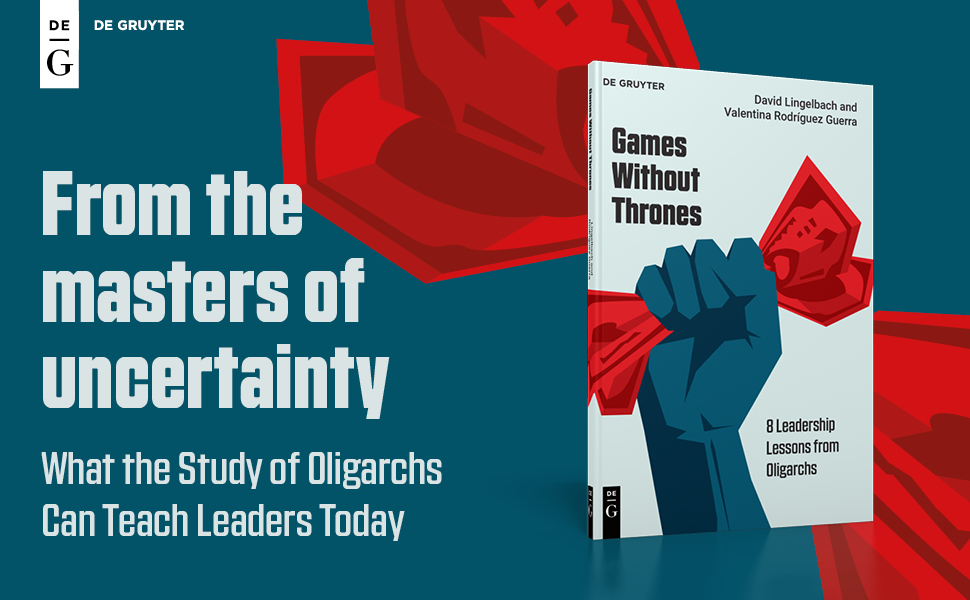
Valentina: In 2022 David was writing a book proposal for the book that became our book, The Oligarchs’ Grip: Fusing Wealth and Power. He reached out to me and asked me to join as the 50/50 co-author for this writing project. From there our collaboration has deepened to include two additional book projects: Games Without Thrones: 8 Leadership Lessons from Oligarchs, and The Oligarchs of the Americas: From the Conquistadores to Silicon Valley. In 2024 we also established an NGO, The Center for the Study of Oligarchs, to institutionalize our work.
Valentina: We write to think about and better understand the phenomenon of oligarchs. We have been studying this phenomenon for more than 30 years collectively. Writing helps us to clarify what we do and do not understand. We also write to help others to form their own views about oligarchs, based on rigorous research.
David: This is probably a good point at which to clearly define oligarchs, and what makes them different from other, adjacent actors. Aristotle defined oligarchs as the wealthy few who govern us. We update that definition and say that oligarchs are economic and political actors who secure and reproduce wealth or power, then use one to gain the other.
That makes oligarchs different than billionaires or wealthy people generally, who have wealth but not necessarily power. It also makes oligarchs distinct from strongmen and autocrats, who exercise power but are not wealthy. Of course, oligarchs can be billionaires and strongmen as well.
Paul: Journalists around the world are being arrested, attacked and even murdered. You are taking on some very powerful people who do not like to be exposed and their wealth machines threatened. Has either one of you been attacked, threatened online, by phone, mail or in person?
Valentina: Fortunately, we have not been threatened or attacked for our work so far to any significant extent. David did receive an emailed death threat a few years ago in response to something we wrote about Putin, and we have had the very occasional social media issue. But nothing that has concerned us.
Paul: Disturbingly and increasingly this threat comes from within. Democracy is being dismantled by many elected leaders whose only goal is centralizing and concentrating power. Leaders call factual news reporting that contradicts them “fake news” and install ideological loyalists in key government positions. What is the danger here?
David: Of all the developments surrounding oligarchs today, we are the most concerned by the use of technology to shape how people think and act. This began with search, continued with social media, and now is most disturbingly evident with artificial intelligence (AI). The amount of wealth and power that tech oligarchs have accumulated, and the speed at which this accumulation has occurred, is unprecedented. These platforms have become the vehicles through which disinformation has been distributed.
Valentina: Of course, we had media oligarchs before this era, actors such as Canada’s Conrad Black and, of course, Rupert Murdoch. They have played a significant role in setting agendas in societies across the world. And in some instances, their outlets spread disinformation. But there were more checks and balances then than there are now with AI and social media. Both platform types remain substantially unregulated.
Paul: Police are given more powers of search and seizure with no warrants and more prisons are being built including in Canada. What have you learned here?
Valentina: We have not studied policing and prison expansion systematically, but some oligarchs have utilized expanded police powers and prison building as part of their strategy. A good example is El Salvador’s Nayib Bukele, whose state of emergency resulted in the arrest of tens of thousands and a variety of unconstitutional actions. Bukele remains very popular and powerful as a result, reflecting Salvadorans’ fatigue with decades of violence and uncertainty.
Paul: Emblematic of authoritarians are the tools of fear and intolerance propaganda against immigrants and particularly the LGBTQ and transgendered people. In 2024 we saw Conservatives in Canada jump on the anti trans bandwagon, even using extraordinary legislation to take away their rights. Can you comment on the dangers here.
David: The use of “the other” as a tool for expanding power is well known and commonly used, and not just or even mainly by oligarchs. We think it’s always important to ask when fear and intolerance are used: who benefits? Who gets rich from such tools? We have not studied campaigns against immigrants, LGBTQ people, or transgender people systematically, so we would be cautious about making broad claims.
Valentina: Our approach is therefore to ask a narrower set of questions: Who gains power from the campaign? Who gains wealth? Does it help particular actors convert political power into economic advantage, or economic power into greater political control? Those questions can help determine whether oligarchs are involved, without presuming the answer in advance.
Paul: What makes this day and age more uncertain and more dangerous than the Gilded Age of the 19th century and what can we learn from those times?
David: This is a big and important question! Uncertainty is the oxygen that oligarchs breathe. It creates opportunities that their skill set is best positioned to exploit.
Uncertainty has been on the rise globally since the mid 1970s, when the postwar economic settlement began to fall apart. The milestones on this journey are well known: the oil price shocks of the 1970s, 9/11 and the resultant forever wars, the 2007-8 global financial crisis, and the COVID-19 pandemic, to name a few. Oligarchs have every incentive to fuel further uncertainty, as it gives them more and more opportunities to gain wealth and power.
Valentina: The Gilded Age was less global than the age of uncertainty in which we live today. But it holds one lesson. It led some societies, notably the United States and the Scandinavian countries, to react against and begin to contain oligarchs.
Paul: In your view, what has driven the weakening of our democratic institutions over the last few decades?
David: We are not democracy researchers, and we defer to colleagues like those at V-Dem on this matter. Having said that, we believe that the rise of the oligarchs since the mid 1980s is related to the democratic backsliding we have been witnessing. But the correlation between rising oligarchs and falling democracies is very imperfect. It is perfectly possible for oligarchs to rise and prosper in functioning democracies. The United States and India are good examples.
Paul: Today, Oligarchs have control of governments in many countries and rising in many more. Who are these people and how have they come to dominate our world?
Valentina: The rise of the oligarchs that we mentioned earlier has led to the creation of an oligarchs’ world order. That order has now largely replaced the liberal, rules-based international order that developed after World War II. That transition began in earnest in 2017, when Trump was elected for the first time.
David: The numbers on this are quite revealing. Approximately 57% of the global economy today is generated from economies run by oligarchs. In 2026 47 countries have had oligarchs as heads of state or government. By our coding and definition, seven of the world’s 10 wealthiest people are oligarchs.
Valentina: Oligarchs come in two main varieties: business and political. Business oligarchs acquire wealth first, then make the move to power. Trump is a good example of that. In a different way so is Musk. Political oligarchs move in the opposite direction: power first, then wealth. Putin is a good example. A handful of oligarchs seem to gain wealth and power almost simultaneously. Saudi Arabia’s Mohammed bin Salman is an example.
Paul: How did they come to dominate our world?
David: We identify four main causes. First, as we mentioned, uncertainty, which generates opportunities. Second, inequality, which gives those at the top preferred access to those opportunities. Third, institutions, which enable oligarchs to protect the wealth and power they have acquired. And fourth, agency, the ability of individual oligarchs to play the field created by uncertainty, inequality, and institutions.
Paul: It seems to me that crisis capitalism is one of the main strategies used by oligarchs to increase their wealth. Can you comment on how crisis capitalism works?
David: We were initially sceptical about concepts like crisis capitalism and the shock doctrine. But, having done some field research in Chile, where these concepts first took hold under Pinochet, we can see the connection. A capitalism that is in constant crisis generates the high levels of uncertainty in which oligarchs can thrive. Crisis lowers asset prices, suspends normal scrutiny, concentrates decision-making, justifies emergency measures, and allows actors with capital and access to acquire assets or privileges on favorable terms.
Paul: It looks like the oligarchs’ government servants are on a privatization rampage of public assets and services. They already own just about everything. What role will oligarchs play when it comes to the privatization of and access to water on a global scale?
Valentina: We have not researched the relationship between oligarchs and water privatization systematically. So we are cautious about making broad claims.
David: What we can say is that water scarcity creates the kind of uncertainty in which actors with capital, political access, and control over infrastructure may gain advantage. Water is also different from most commodities because people cannot opt out of needing it. That makes questions of water ownership, pricing, regulation, and access especially important.
Valentina: The key issue for our research would be whether control over water allows particular actors to convert economic power into political influence, or political influence into protected economic gain. Where that occurs, water may become another arena in which wealth and power reinforce one another.
Paul: Why is your book, The Oligarchs Grip: Fusing Wealth and Power, the one book that everyone who is anxious about the world crisis needs to read?
David: There are only a handful of books that we would consider foundational for understanding oligarchs. The Oligarchs’ Grip makes a distinctive contribution because it focuses not simply on extreme wealth or political corruption, but on the process through which wealth becomes power and power becomes wealth. Our latest book, Games Without Thrones: 8 Leadership Lessons From Oligarchs, helps today’s leaders to be more effective by studying what oligarchs are doing in this period of high uncertainty, without becoming oligarchs themselves.
The book also treats oligarchs as a global phenomenon rather than as something confined to Russia, the post-Soviet world, or a small number of authoritarian states. We examine business and political oligarchs across very different societies and ask how they think, act, make decisions, protect themselves, and reproduce their advantages over time.
Valentina: That matters because many of the crises’ people are anxious about today, such as democratic weakening, technological concentration, inequality, war, and the erosion of public trust, cannot be fully understood without examining the people who sit at the intersection of wealth and power.
David: We do not claim that ours is the only book people should read. Jeffrey Winters, Thomas Piketty, and Shoshana Zuboff are also essential to gaining a fuller picture. But The Oligarchs’ Grip and Games Without Thrones provide a framework for recognizing oligarchs, understanding how they operate, and thinking seriously about how they might be contained.
Paul: If these oligarchs are not stopped or contained, what might a future under their control look like?
Valentina: We have realistic hope that oligarchs can in fact be contained. We have written a fair bit about this already, most recently in the Washington Monthly and D+C Development and Cooperation. Containment will require a global, distributed, and largely non-governmental effort; too many major governments have been captured already for containment work to be done at the national level for the foreseeable future. Local government also seem to be important.
David: Having said that, we don’t think the oligarchs’ world order has reached its peak yet. Our best guess is that it will peak at something like 70-75% of the global economy, before receding. That will be a multi-decade process.
For the average person, the oligarchs’ world order does not feel dramatically different. It is experienced as a steady narrowing of life. Housing, health care, education, energy, and communications become more expensive, while wages and public services lag behind. Elections continue, but the range of policies that can seriously threaten concentrated wealth and power grows smaller.
Valentina: News and social media increasingly reflect the interests of their owners and advertisers. Workers feel more replaceable; small businesses face markets tilted toward dominant firms. Citizens are encouraged to blame immigrants, minorities, or one another for problems rooted in the concentration of wealth and power. The defining feeling is not simply poverty. It is powerlessness: the sense that the most important decisions affecting one’s life are made elsewhere, by people who cannot easily be held accountable.
David: In short, for the average person, the oligarchs’ world order means paying more, having fewer real choices, and possessing less power over the institutions that shape everyday life. Today, people feel that the system is unfair. In the future, they may feel that the system no longer needs them.
Paul: This is a big one, maybe the biggest. Many people today are discouraged, in despair, feeling powerless and can do nothing about today’s world crisis. Is it too late?
David: To be blunt, it is very late in the game. But the single best thing people can do today is to understand oligarchs and what we are dealing with.
We often talk about oligarchs as similar to wolves you might encounter in the forest on a dark winter’s night. What would you do in response? You would first need to recognize the danger clearly, understand how the animal behaves, and avoid actions that make you more vulnerable. That is the level of understanding people must develop if we are to contain oligarchs. Citizens cannot simply outsource this thinking to politicians.
Valentina: The next step is to learn to recognize the conversion of wealth into power and power into wealth in particular institutions, industries, and political systems. Citizens can then direct their attention toward measures that interrupt that conversion: stronger institutions, enforceable limits, greater transparency, and organizations capable of sustaining pressure over time.
David: No individual can do this alone. But people are not powerless when they understand the problem accurately, organize around specific points of leverage, and support institutions that have shown some capacity to contain concentrated wealth and power.
Paul: Is it possible to win a better world and contain these extremely wealthy and powerful people?
David: It is possible to contain oligarchs. We have historical examples. Ancient Greece. 1930s Scandinavia. The Progressive Era in the United States. Postwar Japan. 2026 Hungary. We need to direct our energies toward what works and away from things that feel good in the moment: protests, social media likes, and whining.
We also need to be clear-eyed that existing organizations, including political parties, may not be effective vessels for oligarch containment.
Paul: What lessons can we as citizens of the world learn in order to understand what is needed for the global majority to reclaim our democratic power?
Valentina: Walter Scheidel’s work reminds us that, historically, the most dramatic reductions in severe wealth and income inequality have usually followed four kinds of catastrophe: mass-mobilization war, revolution, state collapse, and pandemics. That is an uncomfortable but important finding. It reminds us that our ability to produce large-scale equality peacefully has often been limited.
David: But reducing inequality and containing oligarchs are not exactly the same task. Containment does not require eliminating wealth or producing complete equality. It means preventing individuals from converting wealth into unchecked political power, or political power into protected private wealth.
History therefore offers some grounds for hope. Societies have contained oligarchs through stronger institutions, enforceable limits, progressive taxation, competition policy, labor power, public provision, and restrictions on the concentration of political and media influence. These measures are difficult, and they are rarely permanent, but they do not require war, revolution, collapse, or a pandemic. The additional challenge today is the extraordinary wealth and power of the tech oligarchs, and containing the effects of their technologies without becoming anti-technology.
Valentina: The lesson for citizens is to be realistic about both the scale of the problem and the limits of individual action. The goal is not simply to express opposition. It is to organize, build and defend institutions capable of interrupting the fusion of wealth and power over long periods of time.
Paul: What is the pathway to stop this profit at any cost destruction of the planet?
David: We have argued that oligarchs are at the center of the other grand challenges facing the planet: global warming, nuclear conflict, AI, pandemics, and biodiversity loss.
Containing oligarchs would not solve these problems by itself. But it would weaken one of the major forces that makes them harder to solve: actors with enough wealth and power to block regulation, shape public debate, shift environmental costs onto others, and protect profitable activities even when those activities impose severe public harm.
Valentina: The pathway therefore involves identifying where concentrated wealth and power are preventing collective action, then building institutions capable of limiting that influence. If we can contain oligarchs, these other challenges become more possible to correct. If we cannot, it becomes much harder to see a clear path forward.
Paul: summing up, it is uncertainty that fuels oligarchs and organizing to contain Oligarchs is where we need to go.
Excerpt from the Oligarch Chronicles “We must begin again the process of building a cage of international laws and regulations for capitalism, this time an enforced, escape proof one.”
This interview was conducted by video chat on Wednesday July 22.
Support rabble today!
We’re so glad you stopped by! Thanks for consuming rabble content this year.
rabble.ca is 100% reader and donor funded, so as an avid reader of our content, we hope you will consider gifting rabble with a donation during our summer fundraiser today.
Whether it be a one-time donation or a small monthly contribution, your support is critical to keep rabble writers producing the work you’ve come to rely on as a part of a healthy media diet.
Become a rabble rouser — donate to rabble.ca today.
Nick Seebruch, editor