


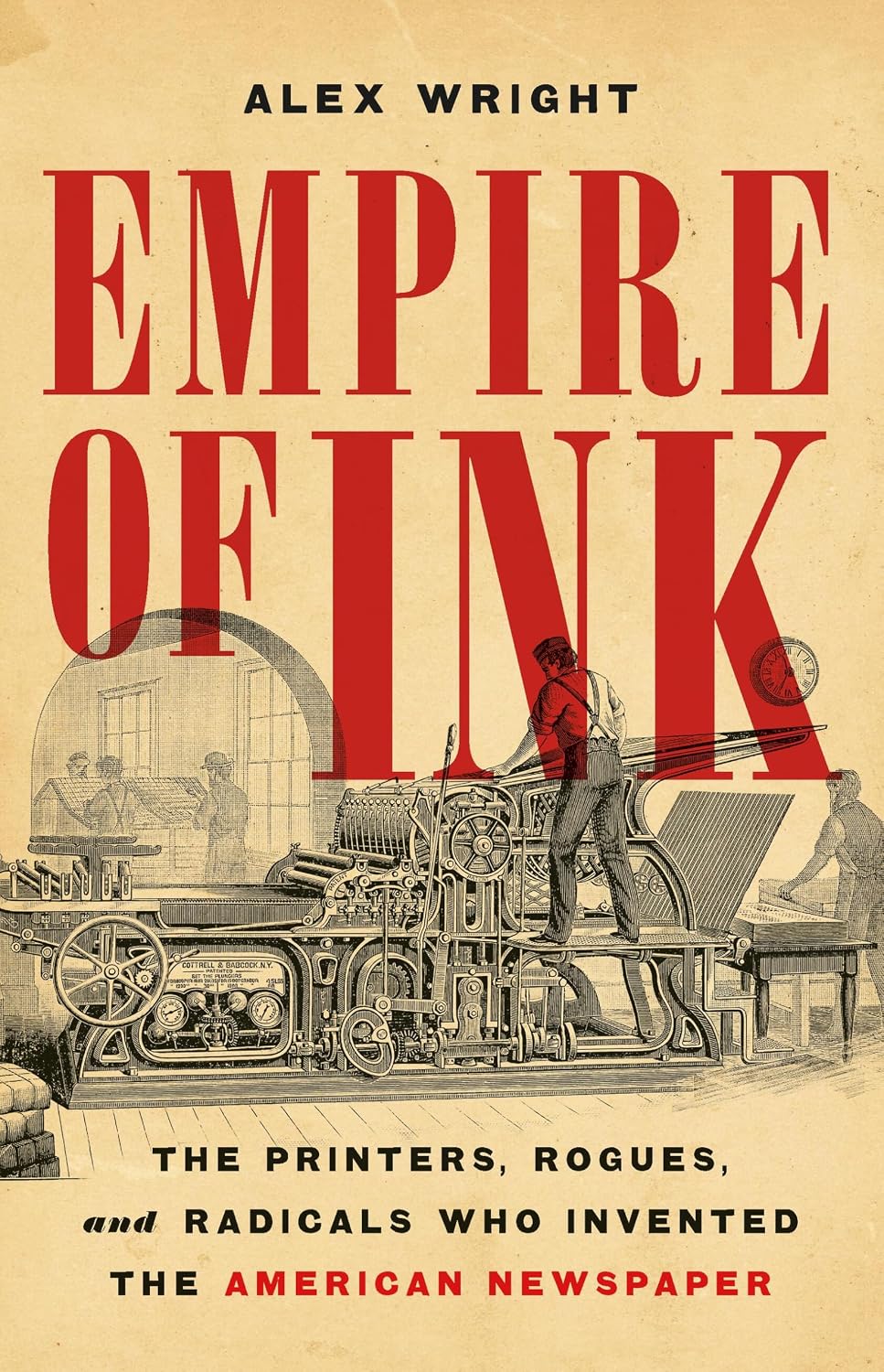
It begins with printer’s devils. These ink-stained pressroom apprentices play an outsized role in Alex Wright’s Empire of Ink: The Printers, Rogues, and Radicals Who Invented the American Newspaper. The book is Wright’s retelling of how a rough-hewn community press slowly morphed into modern-day media capitalism. Or as he puts it, “a noisy, splotchy print culture gave way to the streamlined conventions of modern journalism.”
The evolution of United States newspapers has been told countless times, but Wright adds some interesting new twists. With his background in digital technology, for example, he connects the devils of 200 years ago with today’s social media engineers. He compares 18th century tramp printers to the modern economy’s gig workers. He sees “similarities and resonances between the cacophonous caterwaul of nineteenth-century newspapers and our present-day digital media landscape.”
That landscape was navigated by the devils of old who would graduate to tramp printers who started weekly newspapers in boom towns across North America. Among many others, we are asked to recall the sycophantic editor in Deadwood, the wild and dangerous South Dakota mining camp where Wild Bill Hickcock spent his last days.
These were men, and some women, who gathered the news, gossip and get-rich-quick promises to be set in type by hand and printed on hand-presses that they often carried on their backs. They were itinerant vagabonds that roamed the U.S. throughout the late 18th and 19th century, using their wits and occasionally a Colt .45 to make a buck before moving on to the next camp. Canada gets only the odd mention, but it also had its tramp printer’s heyday.
Wright takes us back to the first newspaper in the English colonies, published in 1690, and moves us through several stages of development and several celebrated printer’s devils. The first famous one is Benjamin Franklin, the Boston printer who plays a major role in the American War of Independence.
“Franklin made one of the earliest and most persuasive cases for a free, pluralistic press,” Wright states. But the press was still largely governed by political parties and commercial interests more than a desire for fairness in news.
When the British parliament passed the Stamp Act in 1765, the “lively, rambunctious press” forced the repeal of the act that demanded they pay a penny for each paper sold. With that victory, the printers discovered “their power to shape legislative priorities.” Here was an institution capable of “uniting people around a common cause.”
That cause was soon to break the 13 colonies from the shackles of the British Crown. Wright boldly argues that “the Revolution might never have happened at all were it not for the influence of colonial newspapers.” These weekly papers helped expand the public sphere.
“None of this would have happened without the ink-soaked, apron-clad artisans who coaxed the fledgling republic to life in print,” he writes.
Throughout, Wright offers readers a detailed outline of the newspapers that led to a “freewheeling editorial culture” and the possibility of a sustained livelihood. There was profit to be had through sales and subscriptions but more importantly through advertising. Often these editors lacked literary ability, but by clipping news items from other newspapers – a newspaper exchange network – they could cobble together a four-page chronicle. Wright documents the rise of the commercial press and the advent of syndicated services that profited from the sale of “boilerplate” pages of clipped news.
For others, it was less a business and more a crusade. In the early 1820s, for example, The Phoenix was printed in both Cherokee and English. It and other early First Nations newspapers provided vehicles to help people in “their struggles to seek justice and preserve their cultural identity.”
The first Jewish paper, The Jew, founded in 1823, stood up for Jewish religious rights. In 1827, Freedom’s Journal became the first Black newspaper in the U.S. In 1853, The Oriental was launched to provide “vital channels for communication, solidarity, and identity formation.”
The anti-slavery press of the mid-1800s, led by pacifist William Lloyd Garrison’s The Liberator and former slave Frederick Douglass’ The North Star, fought for the abolition of slavery.
The women’s press broke into the “male-dominated public sphere” with The Lily, which provided a place for prominent women’s rights voices like Susan B. Anthony and Elizabeth Cady Stanton.
“What began in the pages of papers like the Cherokee Phoenix, The Lily, and The Liberator grew into a set of overlapping reform movements,” Wright notes. Here “we can see the vibrant, heterogeneous cultural heritage that constitutes America’s true birthright.”
Technological innovations are well documented in Empire of Ink, including the rotary press, which led to the penny press as the precursor to mass newspapers. He also discusses the origin and refinement of printing paper, the coming of news wire services, today’s online computers, and the social media revolution. The latter compares to the founding press.
It was the American Civil War, Wright explains, that “forever transformed the practice of American journalism.” The telegraph, started in 1844, accelerated the spread of news to the country’s 3,725 newspapers at the start of the war in 1861. By then, the Associated Press news service had formed, giving small-town editors “a lifeline to the wider world.”
The war also gave rise to several newspapers produced by soldier-printers that kept the troops informed. Poet Walt Whitman, another printer’s devil, who would publish his work about the war in his famed Leaves of Grass, made his living as a compositor at several newspapers. His quest to follow the “open road” and his rambling lifestyle celebrated the tramp printer tradition. Whitman was a proud promoter of that tradition.
“Despite their rakish reputation, tramps also cultivated a deep devotion to the craft and a sense of shared professional solidarity,” Wright said.
After the war, “a wave of amateur newspapers emerged” produced by a new breed of homegrown newspaper that was redolent of the earlier pioneer press with its rough-edged folksy appeal. One of them, Little Nellie’s Little Paper started in 1861 by Nellie Williams, covered the war and local news. It helped “spark a movement” of amateur publishing epitomized by the likes of humourist H.L. Mencken, a “self-made printer’s devil.”
Wright includes profiles of famous writers who commented on the press. Charles Dickens, Ralph Waldo Emerson, Edgar Allan Poe and James Fenimore Cooper take umbrage at the low quality of it. Dickens went on the rampage about it in The Life and Adventures of Martin Chuzzlewit, a satire about a press that is “self-important and predatory.”
Perhaps the best known of Wright’s devils is young Sam Clemens, a.k.a. Mark Twain, the creator of the beloved (and controversial) Huckleberry Finn. The writer starts out as a devil but he climbs to great literary heights before succumbing to an insatiable desire for riches. His luck runs out and he faces a rapid downfall resulting from a bad investment in a competitor to the Linotype machine.
Wright has worked for Google and The New York Times, a seemingly contradictory employment record, but his thesis about where the mass media came from and the connection to its current struggle to reset in the 21st century makes him a suitable analyst. He sees a “hopeful path forward – one that fuses the freewheeling public sphere of the early nineteenth century with a renewed iron core of journalism.”
Empire of Ink does much to fill this “overlooked chapter in American history.” Wright envisages AI and other new technologies not as a threat but an opportunity to reboot the “raucous conversation of American democracy,” to re-energize “a flowering of bottom-up, grassroots media.” But he adds a warning: “every new communications medium, from the penny press to the digital news feed, carries the promise of free expression alongside the risk of consolidating power in fewer hands.”
Today’s printer’s devils no longer set type by hand or ink presses with leather balls, but those who work the social media beat may still play some devil’s mischief by jamming the machinery of the billionaire press with new ideas, exposés of wrongdoing, and an unremitting quest for truth in media. We can hope.
Support rabble today!
We’re so glad you stopped by! Thanks for consuming rabble content this year.
rabble.ca is 100% reader and donor funded, so as an avid reader of our content, we hope you will consider gifting rabble with a donation during our summer fundraiser today.

Whether it be a one-time donation or a small monthly contribution, your support is critical to keep rabble writers producing the work you’ve come to rely on as a part of a healthy media diet.
Become a rabble rouser — donate to rabble.ca today.
Nick Seebruch, editor
