
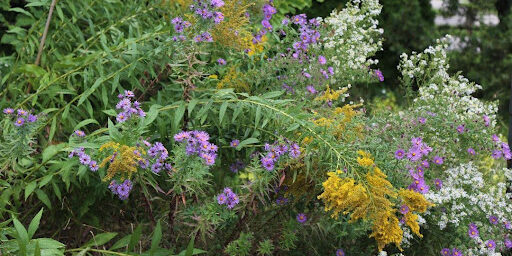
More than once, City of Burlington bylaw officers and city workers have cut down Karen Barnes’ naturalized garden. The City of Burlington also notified Barnes, and her mortgage company, that they intend to fine Barnes $400,000 for non-compliance based on a flat fee of $100,000 plus $10,000 per day until she conforms to the bylaw.
Thirty days after issuing the notice the City sent workers to cut down the garden again. So, 30 days at $10,000 per day racked up $300,000. Yet, Barnes’ garden contains no noxious weeds nor prohibited plants, simply native species some of which are found on the endangered species list for Ontario.
After seven long years, the City of Burlington is taking Barnes and her daughter, Julia Barnes, to court because their naturalized garden apparently “doesn’t conform to bylaw standards.”
The entire situation is completely unbelievable because 29 years ago, Toronto resident, Sandy Bell, won a landmark case in Ontario. The 1996 ruling established that naturalized gardens, expressing environmental beliefs, are protected under the Canadian Charter of Rights and Freedoms’ freedom of expression — as long as they don’t pose public safety risks. Why, then, is the City of Burlington waging war on native plant species thriving on private property.
Karen Barnes has a master’s degree in ecology. She is a habitat gardener living in Burlington who began rewilding her yard in 2015. Julia Barnes is an award-winning documentary filmmaker whose work focuses on protecting nature.
Naturalized gardens vs. grass lawns
Naturalized gardens differ from grass lawns in terms of their environmental impacts and the relationship with nature that they represent as well as the specific species found in them.
It’s important to discuss the hypocrisy of the City of Burlington and its naturalized garden bylaws over the past several years starting in the summer of 2018 when Barnes, Paul Raun and myself received notices to remove native plants, and in Paul’s case native trees as well, otherwise the city would cut down our gardens and bill us.
In 2018 the City of Burlington served me with a notice to cut down my common milkweed that was thriving in my naturalized garden. Refusing to comply meant the city would cut down my entire naturalized garden while billing me for the cost of that work.
At that time, the city had been giving away common milkweed seeds and plants for folks to plant in their home gardens. The city even had common milkweed growing on city property throughout Burlington. Local plant nurseries were selling milkweed plants and the David Suzuki Foundation was encouraging folks to plant common milkweed.
Six days later, after an influx of emails from folks across Canada pointing out common milkweed had been removed from the provincial noxious weed list in 2014 and was a plant that monarch larvae depend on for their survival, the bylaw was changed literally on the eve of my garden’s destruction.

Barnes and Raun were also threatened that year. In Raun’s case the only noxious weed on his property was a dog strangling vine — related to milkweed but deadly to monarch larvae — but the vine was actually rooted in his neighbour’s yard. When Paul asked bylaw if they were going to speak to the neighbour about pulling out the vine that is listed on the Ontario Weed Control Act, bylaw said, “no because no one filed a complaint about that garden.”
Burlington targets naturalized gardens
Then in 2022, the City of Burlington revised its naturalized garden bylaw once again and I have always maintained that the changes specifically targeted the Barnes’ garden.
By-law 49-2022 states, “naturalized area” means an area of vegetation deliberately planted or cultivated with one or more species of wild flowers, shrubs, annuals, perennials, ornamental grasses, or combination of them, that is monitored and maintained by a person.
However, bylaw officers seem to be interpreting this to mean that every plant has to be purposely placed or planted and prohibits self-seeding gardens which is not how the bylaw actually reads. In fact, the city has and maintains its own self-seeding gardens.
Plants cannot be over 20 cm in height. However, most non-native flowering plants sold at commercial nurseries, like hostas, calla lilies, zinnias and Ox-eye daisies, often surpass this height restriction yet, are exempt.
And, I bring up height because the Superior Court of Ontario has accepted evidence that a 20 cm height restriction is irrational given the fact that about 90 per cent of native plant species in Ontario grow higher than 20 cm.
By-law 49-2022 prohibits the use of popular bee homes that attract native solitary bees like mason and leaf cutter bees which are essential pollinators. The by-law also mandates cleaning up fallen leaves where butterfly larvae overwinter; toads, shrews and salamanders hide and hunt; and beneficial microbes and worms thrive.
It’s important to note that while skunks, raccoons, and opossums may forage in naturalized gardens for insects and seeds, they do not live in naturalized gardens because they would be too vulnerable to predators — particularly the human kind. Instead, skunks, raccoons and opossums live under gazebos, decks and sheds when not foraging for ticks, grubs and other nuisance insects.
Author and gardening expert, Lorraine Johnson, wrote a report about the Barnes’ garden that was submitted to the city. Johnson’s report supported the naturalized garden. The city chose to ignore Johnson’s expert advice.
By-law officers making decisions about naturalized gardens work for the building and planning department. In previous interviews for rabble.ca, Johnson has expressed the need for mandatory training for bylaw officers around native species and naturalized gardens. That has yet to be implemented by Burlington.

The lengths the City of Burlington is going to are extremely difficult to understand given the fact that Sandy Bell won her case against the City of Toronto at the Superior Court of Ontario 29 years ago. That win established that naturalized gardens, expressing environmental beliefs, are protected under the Canadian Charter of Rights and Freedoms’ freedom of expression, as long as they don’t pose public safety risks.
Instead of honouring their right to freedom of expression, the City of Burlington is taking the Barnes to court this fall.
It’s worth noting that in April 2019, Burlington City Council declared a climate emergency in order to deepen the city’s commitment to addressing climate change and protecting its economy, environment, and community. Yet, the city has spent time and money over seven years fighting two women who are doing what we should all be doing during a climate crisis, planting native, self-seeding annuals and perennials that are able to live on rainwater, survive droughts and provide shade and food for pollinators, birds and small animals.
We have entered the Anthropocene and the standard suburban lawn with its non-native grasses adorned with non-native, often invasive and exotic, commercially grown plants is only exacerbating our race towards extinction.
Mainstream suburban landscaping demands huge amounts of electricity and gas to power mowers, edgers and leaf blowers; additional watering to keep lawns green during heat waves when water should be conserved; petrochemical fertilizers; and yes, folks still use Roundup and Weed BGon which contain glyphosate as well as 2,4-D, dicamba, MCPP-p, and quinclorac, respectively despite Ontario’s cosmetic pesticide ban that took effect on April 22, 2009. And, yes, herbicides are pesticides marketed under a more “palatable” name but just as toxic and dangerous.
The cognitive dissonance of this entire situation is truly unbelievable and the City of Burlington’s relentless attack on the Barnes’ garden is not only baffling, it’s extremely dangerous.
*Karen and Julia Barnes have set up a fund to help with the costs of their on-going legal challenge. You can donate here.
Feel free to email Burlington City Council about this environmental disconnect during an undeniable climate crisis and Anthropocene epoch. Here’s the Mayor’s and Councillor’s email addresses.
Support rabble today!
We’re so glad you stopped by! Thanks for consuming rabble content this year.
rabble.ca is 100% reader and donor funded, so as an avid reader of our content, we hope you will consider gifting rabble with a donation during our summer fundraiser today.
Whether it be a one-time donation or a small monthly contribution, your support is critical to keep rabble writers producing the work you’ve come to rely on as a part of a healthy media diet.
Become a rabble rouser — donate to rabble.ca today.
Nick Seebruch, editor