
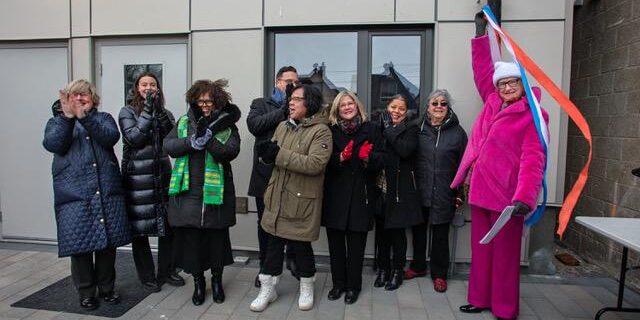
Fifteen Hamiltonians moved into furnished apartments at 412 Barton St. this month. The deeply affordable new build was the vision of St. Matthew’s House (St. Matt’s) executive director, Renée Wetselaar who saw potential when the façade of St. Matt’s foodbank literally tumbled into the street.
Purposely constructed for Indigenous and Black adults aged 55 and over facing homelessness, the six-story building has common space for community events including a full kitchen adorned with a colourful wall mural painted by local Cayuga Woodland artist Kyle Joedicke. Washrooms and staff offices round out the ground level. Each of the five remaining floors contains three studio apartments and a communal laundry room.
“The 412 Barton is a unique project serving Black and Indigenous Seniors 55 and over. Fifty per cent of the units are for women. We worked in partnership with the Hamilton Regional Indian Centre and the Afro-Canadian Caribbean Association for the selection of tenants and the provision of supports planned,” Wetselaar told rabble.ca.
“This is the first time in Hamilton that the Black community in particular has had the opportunity for inclusion and autonomy in decision making for this type of housing. We hope to continue this partnership for years to come,” she added.
Half the units are reserved for women because they disproportionately face more difficulty finding affordable rental housing. Women, particularly women of colour, often work in the care economy that generally pays little more than minimum wage . Many also work part-time to accommodate caring for their own children and other family members; and are employed in jobs that quite often don’t provide a pension or provide one of any value.
“This project is about more than housing. It is about dignity, stability, and ensuring Black and Indigenous seniors have equitable access to safe, affordable housing,” Evelyn Myrie, President of the Afro Canadian Caribbean Association told rabble.ca via email.
Social supports for 412 Barton St. residents
St. Matt’s staff has designed and implemented crisis and eviction prevention supports to ensure elders living at 412 Barton are supported and meaningfully engaged while maintaining their autonomy and driving their own self-development. Services include help accessing government and social services as well as supports around nutrition, mental health, physical mobility, and spiritual needs. Local doctors also provide house calls.
Deeply affordable rent at 412 Barton means residents pay about $200 a month for their unit, utilities and internet with the City of Hamilton contributing an $800 monthly subsidy.
The history of St. Matt’s
St. Matt’s has a long and storied history of compassion and community building starting with Compass, a store-front located in Hamilton’s North End started by St. Matthew’s Church in 1964 in coordination with six additional Anglican parishes. After a fire destroyed St. Matthew’s Church in January 1966, the property was sold and a portion of the money was used to purchase the Salvation Army Citadel on Barton Street. In 1967, St. Matthew’s House opened at 414 Barton Street East.
By the time the dynamic Wetselaar became executive director a mere seven and a half years ago, the registered charitable, non-profit was on the verge of bankruptcy. That’s when Wetselaar’s years of expertise overseeing the founding of the Workers Arts and Heritage Centre as its executive director before becoming Manager of Community Developers of the City of Hamilton’s Neighbourhood Action Strategy (NAS) with the Social Planning and Research Council of Hamilton (SPRC) set St. Matt’s on a new trajectory.
That path included expanding its outreach street programing, opening an emergency foodbank dedicated to elders, creating Seniors in the Kitchen home food deliveries and partnering with the City of Hamilton to create the Warm Bus program. There’s also the Cathedral Café that served well over 50,000 meals in 2025 and over 57,000 in 2024. Wetselaar’s changes extended to giving the organization a fresher name – St. Matt’s
The quality of life for residents of Ward 3
St. Matt’s supports the residents of Ward 3, also known as Hamilton Centre. Described as an urban ward situated in the lower city, it’s home to U.S. Steel Canada and ArcelorMittal Dofasco. In fact, about one-third of the ward is industrial and commercial land with housing scattered throughout. It’s also home to Hamilton General Hospital, Tim Hortons Field, Gage Park and Hamilton’s Children’s Museum.
While the “average” 2020 income for Ward 3 is reportedly $73,500, in a city that averaged $108,700, a closer look at the numbers tells a very different story. In fact, 64 per cent of residents earned $79,999 or less with a full 15 per cent earning less than $25,000 in 2020. Twenty-six per cent of elders were designated low income compared to the city’s average of 12 per cent.
The unusually high concentration of payday loan centres and the fact that Ward 3 was strategically targeted by Canadian Blood Services as a site for one of its paid plasma collection centres comes as no surprise.
According to the City of Hamilton, in 2021, 23.4 per cent of residents in Ward 3 identified as visible minorities with 8.7 per cent identifying as Black and 5.4 per cent identifying as Indigenous. Women headed single family households made up 23.5 per cent of the families captured by the 2021 census. Over 91 per cent of Ward 3 residents are Canadian citizens.
Living within a concentrated industrial area known for its poor air quality where residents have a long history of lower incomes and higher rates of poverty, has led to the average life expectancy in parts of Ward 3 being 20 years shorter than in wealthier parts of the city where folks live to an average 81.3 years of age (2015-2017 data).
That’s what made the December 9, 2025 official opening of 412 Barton so special. To mark the occasion, instead of the traditional ribbon cutting, those involved in the project, including Mayor Andrea Horwath and Ward 3 Councillor Nrinder Nann, were invited to untie the bow at the centre of the ceremonial ribbon.
Funding 412 Barton St.
The total cost for 412 Barton was $8.3 million. St. Matt’s raised $1 million through a community capital campaign with an additional $3.85 million in federal funds from Canadian Mortgage and Housing Corporation, and the Rapid Housing Initiative through the National Housing Strategy. $2,520,880 came from the province, $1,713,465 was provided by the City of Hamilton through the affordable housing accelerator fund and $100,000 came from the Anglican Diocese of Niagara as part of its commitment to Truth and Reconciliation.
Each studio apartment is furnished and includes a kitchen and fully accessible washroom. Cleaning supplies for each tenant were donated by the Hamilton-Burlington Junior League while bedding, dishes, pots and pans came from St. Paul’s Anglican Church in Glanford, a town that amalgamated with Hamilton in 2001.
Housing as reconciliation
Dimensions of the narrow lot meant traditional construction methods were not going to work. Instead, the structure was constructed off-site before being assembled onsite in less than three months.
According to land use planners, LandWise, “The building performs 25 per cent better than code, using nail laminated timber (NLT) floor panels and light wood frame (LWF) walls that deliver on quality and cost-effectiveness. Inside, high ceilings, natural light, and exposed Canadian timber support resident comfort and well-being.”
Running through the entire project is the knowledge that the land 412 Barton sits on originally belonged to, and was stewarded by, Indigenous people. St. Matt’s sees 412 Barton as an act of reconciliation. The inclusion of both the Indigenous and Black communities reflect St. Matt’s commitment to the work of equity and justice.
“As a community partner, we look forward to helping seniors thrive and get connected to the community by providing culturally relevant programming through this collaboration. Our role in tenant selection is important, as it helps ensure the building reflects equity in practice, not just in principle, by supporting seniors who have historically faced barriers to housing and who deserve to age in place with respect and security,” Myrie said.
Support rabble today!
We’re so glad you stopped by! Thanks for consuming rabble content this year.
rabble.ca is 100% reader and donor funded, so as an avid reader of our content, we hope you will consider gifting rabble with a donation during our summer fundraiser today.
Whether it be a one-time donation or a small monthly contribution, your support is critical to keep rabble writers producing the work you’ve come to rely on as a part of a healthy media diet.
Become a rabble rouser — donate to rabble.ca today.
Nick Seebruch, editor